Monday, December 28, 2009

App Store Download Statistics Suggest Strong iPod Touch Holiday Sales

"MobileCrunch reports on data from mobile analytics firm Flurry showing very strong App Store download performance coming from iPod touch devices, suggesting a strong holiday season for Apple's premier iPod line. On Christmas Day, Flurry's data saw download volume from iPod touches increase nearly 1,000% from pre-Christmas levels, spiking well above comparable iPhone downloads, which typically lead iPod touch sales by a considerable margin.


Overall, Flurry's data reveals 51% month-to-month growth in App Store downloads for December using forecast data for the remaining days of the month. Google's Android Market also experienced strong month-to-month growth of 22%, but was unable to match Apple's performance, at least in application downloads.

The apparent tremendous boost in iPod touch-based App Store downloads was not unexpected, as similar indicators of strong iPod touch sales were seen last year."
Written by Eric Slivka

Saturday, December 5, 2009

Apple Acquires Streaming Music Service Lala Media

"It appears the last minute reports of Apple's interest in streaming music company Lala media were true. Both the New York Timesand Wall Street Journal are reporting that Apple has indeed acquired Lala Media.

Lala is a four year old startup company that offers customers streaming music not unlike the popular Pandora music service.

Lala's engineers have built a service that music enthusiasts say is very easy to use. Lala scans the hard drives of its users and creates an online music library that matches the user's collection, making it painless (and free) for people to get their music in the cloud.

Like Pandora, Lala's music is streamed from the internet rather than stored locally. This allowed users to listen to a catalog of over 7 million songs for free as a stream over the web -- much like internet radio. If you wanted to buy the right to listen to a particular song on demand an unlimited amount of times from the web, it would cost $.10. In order to permanently download the song to your hard drive or device, however, it would cost the more traditional $.79-$.89 per song.

Of the acquisition, Apple spokesman Steve Dowling said "Apple buys smaller technology companies from time to time and we generally do not comment on our purpose or plan."

Apple's interest in Lala sparks a number of possibilities for the direction of the company. Pandora's iPhone app, in particular, has been enormously successful by allowing individually tailored music to be streamed over cellular and Wi-Fi connections. It's natural to believe that Apple may offer a competing service for the iPhone based on this acquisition or Apple could also use the technology to bolster their iTunes Genius recommendations with personalized streaming music."
Written by arn

Friday, November 13, 2009

Apple's next-gen iPhone power amp; NASA chemical sensor app

"Apple has reportedly selected a new power amplifier supplier for a new, forthcoming model of the iPhone; and a NASA scientist has used the iPhone to create a chemical sensor.

New iPhone power amplifier

Skyworks has reportedly been tapped by Apple to supply the power amplifier for a new model of Apple's iPhone. According to Taiwanese trade publicationDigiTimes, the company orders its parts from Advanced Wireless Semiconductor Company.

AWSC expects its revenues to grow by 50 percent in 2010, when Skyworks reportedly becomes the power amplifier supplier for the next-generation iPhone. No further details on the new hardware were presented.

Recent reports have suggested a new hardware model of the iPhone compatible with the Verizon Wireless network in the U.S. could debut in the summer of 2010. The first three iPhone hardware iterations all saw an annual summer release.

NASA creates prototype chemical sensor

Jing Li, a physical scientist at the NASA Ames Research Center, has used the hardware connectivity made available in iPhone OS 3.0 to create a "compact, low-cost, low-power, high speed nanosensor-based chemical sensing" external attachment. The prototype device, which is said to be about the size of a postage stamp, connects to the iPhone through its 30-pin dock connector.

As first noted by Gizmodo, the device can detect chemicals such as ammonia, chlorine gas and methane. The accompanying application can automatically transfer data to other devices.

"The device senses chemicals in the air using a 'sample jet' and a multiple-channel silicon-based sensing chip, which consists of 16 nanosensors, and sends detection data to another phone or a computer via telephone communication network or Wi-Fi," NASA said.

NASA


At Apple's Worldwide Developers Conference in June, Apple highlighted a number of third-party applications that take advantage of iPhone OS 3.0 to connect with external hardware. The new software allows applications on the handset to communicate with external third-party hardware."
Written by Slash Lane

AT&T Publicly Responds to Verizon Ad Campaign

"AT&T today published a public response to a recent series of advertisements from rival Verizon attacking AT&T's 3G network coverage. The latest spat between the two companies began last monthwith Verizon ads using map-based representations of AT&T's and Verizon's 3G coverage areas, with Verizon's network being touted as covering five times the area of AT&T's.

Earlier this month, AT&T filed suit against Verizon for misleading advertising, claiming that the ads implied that AT&T offered no coverage outside of the highlighted 3G areas, when in fact the vast majority of those areas are covered by the company's EDGE network, which the company claims is virtually identical to its 3G coverage with the exception of data transfer speed.

Today's release from AT&T takes its argument directly to the public in an effort to "set the record straight" on what AT&T has to offer. While the release does not directly mention the iPhone, it is clear that the much of the dispute over AT&T's 3G coverage has centered on the popular device.

As the U.S. market leader in wireless data service, we typically don't respond to competitors' advertising. However, some recent ads from Verizon are so blatantly false and misleading, that we want to set the record straight about AT&T's wireless data coverage.

In the release, AT&T details the three types of technology used in its wireless networks (3G, EDGE, GPRS), the functionalities offered by each technology, and the respective coverage areas by population in the United States. The company also touts the breadth of popular smartphones available to customers and the availability of over 100,000 applications, both obvious references to the iPhone. Finally, AT&T notes that it has the "nation's fastest 3G network", which also offers the ability to handle voice and data simultaneously."
Written by Erica Slivka

Saturday, November 7, 2009

Important Apple TV 3.0.1 to Prevent Temporarily Disappearing Content

"Apple has issued a 3.0.1 update to the Apple TV to address an issue that causes content to temporarily disappear from the device. They sent out this email notifying customers:

Dear Customer,
If you've installed the Apple TV 3.0 software update, you should immediately update to version 3.0.1. This prevents content from temporarily disappearing until it is resynced.

To update your Apple TV software:

1. Reboot your Apple TV (unplug the power cord and plug it back in)
2. Select Settings > General from the main menu
3. Select Update Software
4. Select Download and Install

Note: Your Apple TV will conduct a restart, which is followed by the Apple logo and a status bar.
For more information, please refer to this article: http://support.apple.com/kb/TS3116

If you need further assistance with your Apple TV, contact AppleCare.
Sincerely,
Apple TV Team

Apple launched the 3.0 software update for Apple TV last week which overhauled the Apple TV interface and added compatibility for iTunes LPs and iTunes Extras."

Tuesday, November 3, 2009

Pizza Hut's US iPhone app generates $1 million in sales

"The application offers users the ability to zoom in on a virtual fridge for the latest deals

Macworld staff


Pizza Hut's US application for iPhone and iPod touch has surpassed $1 million in sales, generating sizeable income for the company.

Pizza Hut claims that the application is approaching one million downloads, but has yet to debut in the UK iTunes App Store.

The application offers users the ability to zoom in on a virtual fridge for the latest deals, find a local location and save favourite orders. Bernard Acoca, senior director of digital marketing at Pizza Hut, Dallas, TX told Mobile Marketer: "We are extremely excited here about the explosive growth we’ve seen with our iPhone app since its launch 3 months ago, $1 million in sales is pretty substantial for an iPhone app." "From an income standpoint iPhone customers tend to be more affluent, and they’re in the tech-savvy 18-34-year-old demographic skewing slightly male that we tend to go after online,' he said. 'We always saw a steady level of growth with our mobile business via our WAP site, but to be candid it wasn’t the explosive level of growth we’ve seen with the iPhone app" Pizza Hut has more than 10,000 restaurants in more than 90 countries.
"

Monday, November 2, 2009

Apple Pitching iTunes Subscriptions to TV Networks?

"MediaMemo reports that Apple has approached a number of TV networks in recent weeks to pitch its vision of a monthly subscription service that would allow the networks to deliver their content to consumers via iTunes with the idea of replacing consumers' cable packages.

Apple isn't tying the proposed service to a specific piece of hardware, like its underwhelming Apple TV box, or its long-rumored tablet/slate device. Instead, it is presenting the offer as an extension of its iTunes software, which already has a huge installed base: A year ago, Apple said it had 65 million iTunes customer accounts.

A so-called "over the top" service could theoretically rival the ones most consumers already buy from cable TV operators -- if Apple is able to get enough buy-in from broadcast and cable TV programmers.

Apple is reportedly looking to launch the service early next year but faces a number of hurdles, the most significant being that no networks have yet to sign on to the plan. Disney, which holds close ties with Apple CEO Steve Jobs and has been an early-adopter of iTunes distribution offerings, is viewed as the likely leader should the movement hope to gain momentum.

According to the report's sources, TV networks are intrigued by the potential for increased revenue streams that could be afforded by Apple's proposal, but are also leery of harming their existing relationships with the cable companies that carry their programming and advertisers who look to viewership numbers on those systems when targeting their campaigns.

The report notes that other companies, including Amazon, Netflix, Hulu, and Google's YouTube have also been moving into the digital delivery arena, indicating that the time may be right for Apple to make its move.

So Apple's proposed subscription service, which the company has floated in the past, is no longer a huge stretch. Says one executive briefed on the company's plans: "I think they might get it right this time.""

Written by Eric Slivka

Thursday, October 29, 2009

Apple Launches Apple TV 3.0 Software and iTunes 9.0.2

"

Apple today announced the launch of Apple TV 3.0 software, offering a redesigned user interface and compatibility with Apple's iTunes LPs and iTunes Extras, as well as Genius Mixes and Internet radio.

"The new software for Apple TV features a simpler and faster interface that gives you instant access to your favorite content," said Eddy Cue, Apple's vice president of Internet Services. "HD movies and HD TV shows from iTunes have been a huge hit with Apple TV customers, and with Apple TV 3.0 they get great new features including iTunes Extras, Genius Mixes and Internet radio."

The redesigned main menu offers direct access to recently rented and purchased movies, as well as a wide assortment of other content. iTunes LPs and iTunes Extras are available in full-screen, enhancing the viewer experience for audio and video titles.

The addition of Genius Mixes, a feature first introduced last month with iTunes 9, allows users to listen to automatically-selected playlists generated from their iTunes libraries, while the Apple TV 3.0 software also includes support for listening to thousands of Internet radio stations. Finally, the updated software includes additional enhancements for photo viewing, enabling the Apple TV to take advantage of the Faces and Events features found in Apple's iPhoto desktop application.

The impending release of the updated Apple TV software was suggested earlier today by an update to the iTunes Store Terms and Conditions mentioning the 3.0 software.

Update: Apple has also released iTunes 9.0.2, adding support for Apple TV 3.0, a new "dark" viewing option for Grid View, and additional accessibility support.

iTunes 9.0.2 adds support for Apple TV software version 3.0, adds an option for a dark background for Grid View, and improves support for accessibility.

Update 2: PreCentral reports that iTunes 9.0.2 once again breaks media syncing on the Palm Pre.

Here we go again. Apple has updated iTunes to version 9.0.2 and Palm Pre sync is dead again using webOS 1.2.1, despite Palm's Hurculean efforts to spoof nearly every aspect of USB identification known to mankind. As with previous breakages, iTunes does launch when you connect a Pre with Media Mode, but it doesn't appear as a device on the sidebar."

Written by Eric Slivka

Wednesday, October 28, 2009

Apple's Multi-Touch Magic Mouse Now Shipping

"Several MacRumors readers have reported receiving shipping notices from Apple indicating that their Magic Mouse orders have been shipped. At its introduction, Apple announced that while the new multi-touch Magic Mouse is bundled with Apple's new iMac models, the mouse would not be available for standalone purchase until the end of October. The new shipping notices suggest that Apple will be meeting that goal, although customers are still waiting for the device to appear in retail stores.

Apple yesterday released a pair of software updates that will allow Snow Leopard and Leopard users to access the full range of functions on the Magic Mouse. Full support for the Magic Mouse is also apparently being built into Apple's forthcoming Mac OS X 10.6.2 update, which will eliminate the need for future mouse purchasers to install the separate mouse update once that Snow Leopard update is released."
Written by Eric Slivka

Monday, October 26, 2009

iPhone on Verizon: 'A Decision That is Exclusively in Apple's Court'

"Verizon reported its quarterly earnings before the markets opened for trading today, showing increased revenue and subscribers, but decreased profit as the company worked to complete integration of former wireless competitor Alltel amid uncertain economic conditions. As noted by Digital Daily Verizon CEO Ivan Seidenberg claimed in the company's earnings conference call that bringing the iPhone to Verizon is entirely Apple's call and that the carrier would be happy to have it on its network.

During a conference call to discuss Verizon's third quarter earnings, Verizon CEO Ivan Seidenberg said bringing the iPhone to Verizon is entirely Apple's call. "This is a decision that is exclusively in Apple's court," he said. "Obviously we would be interested if they thought it would make sense for them to have us as a partner. And so we will leave it with them on that score. . . We want to broaden the base of choice for customers, and hopefully along the way, Apple, as well as others, will decide to jump on the bandwagon."

Verizon has recently begun targeting both the iPhone and AT&T in recent advertising campaigns, leading to speculation that the carrier does not foresee an introduction of the iPhone on its network and is thus willing to burn bridges with Apple in the new ads.

Offering the iPhone on Verizon's current network would require hardware modifications, given the difference in technology standards used by Verizon compared to all other carriers Apple has partnered with to offer the iPhone. Seidenberg previously noted that the iPhone would be more likely to come to Verizon next year when the company begins rolling out its 4G LTE wireless network, which will utilize the same standards as AT&T and other global wireless companies. Verizon expects to roll out LTE to 25-30 markets by the end of 2010, with full deployment expected to take until 2013."
Written by Eric Slivka

Sunday, October 25, 2009

Inside Apple's new Mac mini Server

"While Appleinsider predicted the arrival of a new dual-drive, optical-free Mac mini, Apple managed keep secret its plans to introduce a new Mac mini server bundle up to its relatively subtle launch this week. Now the company faces the task of publicizing its availability as it works to enter a market it hasn't excelled at in the past.

The new Mac mini server offering isn't just optimized to run Mac OS X Snow Leopard Server, but now actually comes bundled with Apple's server operating systemsoftware. Previously, home and small business users who wanted to try Snow Leopard Server needed to shell out $500 for the retail box version or opt for an Xserve bundle, which starts at $3000 and requires either a server rack or a sizably awkward 17"x30" of free space.

Prior to Snow Leopard, the unlimited user version of Mac OS X Server cost $999; that's what the unlimited user version now costs with the Mac mini server thrown in for free. The server version of the new Mac mini drops the optical drive to make room for two 500GB, 5400 RPM 2.5" (laptop style) SATA hard drives. It also supplies a capable 2.53GHz Core 2 Duo processor and 4GB of fast 1066 MHz DDR3 RAM (expandable to 8GB). This is all fit into the same 6.5" square, 2" high Mac mini enclosure, which weighs in at just 2.9 pounds.

Compared to the conventional, high end model of the revamped Mac mini lineup, you get three times the disk storage (without a built-in optical drive) for just $200 more. So essentially, Apple is now giving away Snow Leopard Server in the Mac mini server bundle just as the company always has on the Xserve. For the first time ever, this provides Apple with an entry-level server to position at the home server niche and relatively sizable small business market.

Mac vs generic PC in the mini server category

Compared to other small form factor PC servers, the Mac mini server supplies a far more powerful processor than the low-powered Atom or Celeron found in many mini computers such as the $350 Asus Eee Box (which is not sold as a server nor really designed to perform like one). That machine also supplies slower DDR2 RAM, lacks the Mac mini's FireWire 800 for fast external expansion, and hard drives top out at 180 GB.

Most importantly however, low cost small PCs typically ship with Windows XP Home in order to cut costs. That means to do "server" things, you'll have to spend at least $460 on Amazon's "Microsoft Small Business Server Standard 2003 R2 32-bit for System Builders," which includes a five user license. Licensing for additional users costs between $50 to $60 each, or can be purchased in blocks of five for $150.

Small Business Server Standard combines a copy of Windows Server 2003 with a version of Exchange Server (for calendaring, contacts and email messaging); Microsoft's Internet Information Services (web server); Windows SharePoint Services (for collaboration); Routing and Remote Access Service (for dialup access, VPN, routing, and NAT services); Windows Server Update Services (for update management across the network); and a fax server.

Microsoft's "Small Business" bundle is designed to serve small office needs without encroaching on the company's larger server business, where it makes its money. For this reason, the Small Business bundle is restricted in various ways. You can only run one instance of it on the same domain (so you can't buy and set up multiple Small Business Servers to run on the same network); it's limited from joining other domains (such as your larger corporate directories); it can only support a maximum of 75 users; and some features are artificially limited in various ways, such as the Exchange database being fixed to no larger than 18GB. That means if you have 20 users, each person's mailbox and calendar would have to be less than 1GB. The 2003 version is also limited to running 32-bit apps only and to using 4GB of RAM.

If you opt for the latest 2008 version of Small Business Server Standard, you have to shell out at least $760 for the first five users, but it allows you to run 64-bit apps and use up to 64GB RAM. Of course, all 64-bit editions of Windows require 64-bit hardware, so SBS 2008 won't run on a low end Atom, Celeron, or Core Duo processors used in most small form factor PCs.

SBS 2008 still imposes the same bundle restrictions however (along with some new ones, such as not being able to use it directly connected to the Internet as a router without an external firewall), so for unlimited, unrestricted use you'd need the full version of Windows Server, Exchange, and SharePoint, which immediately prices you out of the mini server category, as even the licensing for five users begins at a steep $5,900 and quickly inches up to $20,000 for a single server supporting 100 users.

In comparison, the version of Mac OS X Snow Leopard Server bundled on the Mac mini is the same as you'd get at retail or on an Xserve. Like Microsoft's Small Business Server package, Snow Leopard Server bundles both core server features (DNS, DHCP, directory services, and file and print sharing services with support for Macs, Windows, and other Unix/Linux clients); calendar, chat and email services (with mobile push messaging and calendaring support); web and web-based wiki, blog, and calendar collaboration features; routing, firewall, RADIUS, and VPN services; and client machine backups, software update, and group policy management features.

Mac OS X Server also supplies some unique features of its own, including Podcast Producer for automating video editing workflows from capture to delivery; Xgrid distributed processing; QuickTime Streaming Server for broadcasting media streams; and NetBoot/NetInstall for supporting diskless workstations and remote imaging client machines. The product is not restricted to a certain number of users, and any number of Mac mini servers can be set up on the same network, participate in any number of directory domains, and services can consume as much disk space as the hardware allows. Key services are also 64-bit across the board in Snow Leopard Server.

In contrast, Microsoft's lower cost appliance offering, called Windows Home Server, only offers basic file, web, backup, and media streaming services, not all the things a small office user would want to do.

mosxs vs sbs
Apple's fledgling small server business

Clearly, in the small server business Apple can offer something it doesn't offer in the desktop PC market: a huge price advantage on top of its reputation for premium hardware and sophisticated software integration. Still to be determined is whether Apple can convince home users that they need a server, and that they should pay $999 to get one.

Aside from its core customer base of individuals, Apple is also targeting the Mac mini server version at small businesses, most of whom won't need much convincing that they need a server, nor will have much resistance to paying $999 for a solution that makes setting up their workgroup services easy. As noted previously, there isn't much available between the more expensive Windows Server offerings of Microsoft, very basic file sever and media streaming appliances (often referred to as Network Attached Storage), and DIY solutions that necessitate significant Linux savvy to deliver features approaching those of Mac OS X Server.

To reach business users, Apple has to sell companies on ease of use, reliability, and support. Unlike most generic PC vendors with a significant server business such as Dell or HP, Apple does not really offer any suitable support options that larger businesses demand, such as same day or next day service contracts. However, by packaging its server product with low end hardware, Apple may be able to pick off lots of low hanging fruit in small office or home office settings where users are willing to handle their own support.

Making servers simple

Apple's entire business with Mac OS X was to take Unix and make it friendly and usable by mere mortals. Accomplishing this on the consumer desktop certainly wasn't easy (witness the issues with Linux on the desktop), but it was relatively straightforward compared to trying to do the same in a server offering.

The server space is more challenging to productize in the same way because it's harder to pare down what "most people" want to do and then target 80% of those common tasks with simple solutions. Many users who recognize a need for a server outline custom requirements for themselves and subsequently craft specialized systems tuned specifically to solve their needs. This has resulted in lots of popularity for Linux, which provides nearly infinite customizability, but hasn't worked spectacularly for Apple's "one size fits most" philosophy in selling Mac servers.

Apple is not the first company to try to greatly simplify server tools. In large measure, Microsoft introduced the first mainstream server products with push button simplicity in Windows NT, which borrowed its heavy dependance upon a graphical interface and its self-tuning design from the Macintosh. It wouldn't even be much of a stretch to say that Microsoft in the 90s delivered the server product Apple never quite managed to get right during the 80s.

Unix system admins of the previous decade, commonly looked down upon Windows NT as simplistic and unreliable. However, for entry level users who cared more about solving a task than impressing gurus with their command line savvy, Windows NT provided an approachable, understandable foundation for solving information technology needs in small and medium sized businesses.

As Microsoft began to force its way into the server market in the late 90s, it was able to incrementally improve its server offerings and add new functionality to the point where by the end of the 90s, the company and its offerings began to be recognized as credible and legitimate in certain markets. Today, Microsoft's $14.1 billion annual server business is just a hair smaller than its Windows client sales ($14.7 billion) and growing faster than its relatively flat Office sales ($18.8 billion). In terms of operating profits, Microsoft's server group brought in $5.3 billion, compared to $10.8 billion for Windows and $12.1 for Office. That indicates that the server market overall isn't quite as close to printing money as Microsoft's top two segments, but that there's still lots of money to go after in that market.

In like Microsoft

Like Microsoft a decade ago, Apple is working to expand its desktop offerings into the server arena while working against resistance from established platforms and users that aren't quite sure whether to take the company seriously yet. Working in Apple's favor is the fact that the foundation of Mac OS X Server is quite familiar to Unix and Linux experts, and that existing software, including almost all open source packages, are relatively easy to port over to Apple's platform. This is particularly the case in 64-bit computing, where Apple used the same model as Sun Solaris and Linux rather than Windows Server's unique 64-bit model. It also helps that Apple has now certified Snow Leopard Server as being fully Unix compliant.

Apple does appear to share one of Microsoft's biggest challenges: how to sell server software to market that has an abundance of free alternatives. Among Linux vendors and system integrators such as Novell, RedHat, and IBM, money is typically earned for providing expert help in getting Linux to work as desired. This works out as a key advantage for Apple, which doesn't primarily sell software directly like Microsoft, but rather uses its software savvy to add value to its hardware sales. From this perspective, Apple is a Unix integrator rather than a server software vendor.

Until now, Mac OS X Server has been reserved for customers willing to spend around $3000 to $6000 on an Xserve or pay $1000 to upgrade an existing Mac. But with Apple now selling Snow Leopard Server for $500 and bundling it on the new $999 Mac Mini, the company's server offerings will both receive a lot more scrutiny as a small business appliance option and test out the company's resolve to invest long term in the server market.

Opportunity rings

In the company's favor is the fact that lots of businesses are evaluating the iPhone. In Apple's most recent earnings conference call, Chief Operations Officer Tim Cook reported that "employee demand for iPhone in the corporate environment is very strong. Since the launch of the iPhone 3GS, which coupled with the software made a number of improvements that CIOs were looking for, the iPhone is either being deployed or being piloted in well over 50% of the Fortune 100, and from an international point of view, if you look at Europe, this is true in about 50% of the Financial Times 100."

Cook added that "another very key market for us that some people call enterprise is that over 350 higher ed institutions have approved iPhone for their faculty, staff and students, and in addition to both of these, we continue to be very happy with our sales in the government arena."

Mac OS X Server has the potential to leverage the iPhone's popularity among business customers because it offers companies with iPhones a variety of complementary services. Among these are wiki collaboration services that are specifically designed to work great out of the box on the iPhone (below) and a new Mobile Access service that allows iPhone users to securely obtain their email, contacts, and calendar and to access internal company websites using the same SSL protocol that banks use in their online operations.

iPhone wiki


Additionally, Apple supports Snow Leopard Server's CalDAV calendaring, LDAP corporate directory information, and standard Internet email on the iPhone, and supports push email and calendar updates from Server to the iPhone. The iPhone can't help but sell Snow Leopard Server, and the new Mac mini offering provides an easy, low cost way for companies to evaluate these features in supporting their iPhone users.
Two birds, one stone

One problem Apple faces in the server market pertains to scope and range. Is the company trying to be the vendor of a flexible, powerful foundation for building open source solutions which necessitates a certain degree of expertise to deploy and maintain, or does it want to offer a refined, point and click appliance that any Mac user can set up and operate?

Both options present plausible opportunities, but trying to deliver a single product that really fits both scenarios without hemming in power users or bowling over novices is certainly a tall order. And yet that's exactly what the company is trying to do. Rather than hit both targets with one shot however, Mac OS X Server presents two primary faces: Server Admin and Server Preferences.

Server Admin

The first, and oldest, is Server Admin. From this single app, administrators can configure, monitor and manage every major service running on the system, from web, print and file sharing to email and calendars to directory services to video production workflows in Podcast Producer and everything in between.

Server Admin isn't really difficult for new users to figure out, but it presents a lot of complex options that entry level users could find overwhelming. It also exposes plenty of potential to set things up wrong or create configurations that don't make sense or result in problems that would be difficult and expensive to troubleshoot.

For the bleeding edge of power users, Server Admin might only address the majority of what they want to accomplish; users who want to install additional server packages are on their own, and must operate these with the same command line or web-based tools that experienced admins on any other *nix-based server system would use. These users have to proceed with some understanding of how Server Admin works in order to prevent conflict between it and their own custom system configurations.

Server Admin's sweet spot also happens to be Mac OS X Server's primary market: education users and small and medium sized businesses that serve Macs. However, this is not really Apple's mainstream user base. Server Admin presents nowhere near the straightforward usability of iLife and iTunes. In order to set things up using Server Admin, users will need a good grounding in moderately advanced server and networking concepts.

server admin


Server Preferences

Starting with Leopard Server, Apple introduced a new, highly simplified server tool called Server Preferences. It's pattered after System Preferences on the Mac OS X desktop. It doesn't intend to support every service available, nor does to present more than a few basic options for each component.

During initial setup, users who opt for anything other than the advanced configuration are presented with the extremely basic Server Preferences. In very Mac-like fashion, everything is setup to "just work," although this occurs because all of the dangerous choices are simply unavailable.

Using Server Preferences is literally a matter of clicking large buttons, very similar to turning on Time Machine on desktop Macs. Turn a service on, and it's working, configured the way Apple thinks is best. If you want to customize things, you're probably out of luck because Apple has determined that anything you might adjust probably has repercussions you wouldn't anticipate and which would result in a complex and expensive troubleshooting problems that Apple Store Geniuses will only be able to answer with apologetically blank stares.

For users who just want a file server, email and instant messaging, shared calendars and contacts, an Intranet website with rich blogging and wiki features, along with Time Machine client backups and a VPN and basic firewall, Server Preferences does almost everything for you and works without really needing to crack a manual, the way most Mac users would expect of an Apple product.

server preferences


Open Directory: you may not know you need it yet

Apple appears to be banking on Server Preferences to serve as the primary interface for Mac mini server users. Behind its toy-like simplicity, it actually provides lots of very powerful features that many home and small business users don't yet know they need, starting with Open Directory. Apple has integrated a variety of very complex and security-sensitive services, including LDAP, Kerberos and a SASL Password Server, and churned out a deceptively simple directory services product that just works, particularly for small installations where additional integration with other corporate directories isn't needed.

What Open Directory does is manage user accounts and passwords on a network level. Rather than dealing with individual user accounts set up on each Mac in your home or business, Open Directory allows you to create one listing of users that every Mac on the network subsequently consults.

This all sounds very boring, but it unlocks all of the interesting features of Mac OS X Server. It allows you to log into any machine on your network using the same password, and then seamlessly access file servers and services without having to present credentials each time. It also allows you to sync all your files between, say, a desktop and workstation via the server, and to share calendars among users, and to publish internal and public blogs and wikis. And once its set up, you should be able to pretty much forget about it.

The end of innocence

Once users get wind of what other things Snow Leopard Server can do, there's zero work involved in upgrading to an advanced configuration using Server Admin; you just open up Server Admin and begin turning on additional services.

Once this happens however, the childlike innocence of Server Preferences vanishes and you must take on the role of a server administrator, which most definitely will require consulting a reference, and perhaps even paying a consultant.

This makes Apple's choice to bundle its unrestricted, full version of Mac OS X Server on the Mac mini interesting. Users who know they don't want to bite off a complex bunch of trouble will be able to set the product up and use it under the simple Server Preferences. But curious or advanced users will have full control to take on as much complexity as they can manage.

Opportunities in small servers

As noted earlier, Microsoft sells a stripped down appliance version of its server software as Windows Home Server; this does little more than support web and file sharing and some PC backup utilities. There's no collaboration or messaging tools, no directory services domain, and no smartphone integration or anything else. It hasn't exactly taken off like wildfire.

Apple doesn't have a lucrative server software business to protect, so it can throw the whole Snow Leopard Server hog at users and let them set up anything they want, constrained only by the limitations of the Mac mini hardware. There's no missing features, no usage limitations, no client access licensing, and no essential server software that has to be purchased separately.

This is Apple's boldest step yet to expand the visibility of Mac OS X Server into untouched greenfields of opportunity in the emerging small server market. It's also one where there isn't much other competition. This will make it interesting to see how much attention Apple can draw for its new Mac mini server.

AppleInsider will be looking at how well Snow Leopard Server works on the low end, light duty Mac mini in future reports that examine Apple's new value proposition for home and small business users."
Written by, Daniel Eran Dilger

Saturday, October 24, 2009

The iPod turns eight years old

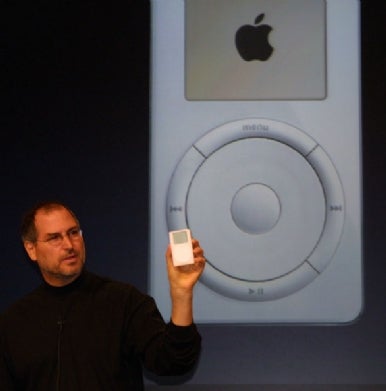
"Do you remember where you were on October 23, 2001? I don’t, but I do remember that Apple make a very big announcement, which—at the time—I thought was a big mistake: the iPod. Today marks the eighth year of the iPod’s existence and these days I find it hard to image a time when the iPod wasn’t a part of the cultural zeitgeist.


Jobs unveils the iPod. (Macworld photo by Rick LePage)
The first iPod had 10 hours of battery life, a FireWire port (which I still miss), and 5GB of storage for $399. Oh, and it was Mac-compatible only. When I first heard about it I thought, “Who the heck even has one gig of music? Dumb move, Apple.” Good thing Apple doesn’t call me up for business pointers because I couldn’t have been more wrong about the iPod if I had tried.


Macworld's Jon Seff, Rick LePage, and Jason Snell at the iPod launch.
Over the years, the iPod has morphed into far more than an MP3 player but today, on its eighth birthday, let us take a moment to remember fondly that simpler time, when seeing someone with white headphones was a rarity and there was a sort of unspoken bond between iPod users. Here's thenews story that ran on Macworld about the announcement, and you can watch the Apple music event in which Steve unleashes the iPod an an unsuspecting world.

Here’s to another eight years of the iPod. (I’m sure that I’ll be amongst the first to line up for the iPod cranial implant that Apple will introduce in 2016.)

For more iPod nostalgia, check out our iPod 5th anniversary podcast, Jason Snell's recollections of that day, a timeline of the first five years of iPod, and a selection of iPod quotes from back in 2001. You can also read Jonathan Seff's first look at the original iPod."

Written by Scott McNulty

Apple Targets Windows 7 With Three New 'Get a Mac' Ads

"

Following through on claims that Apple would launch new advertising targeting Windows 7, the company today posted three new "Get a Mac" commercials to its ad gallery and began airing them on television.

The first commercial, entitled Broken Promises, features PC announcing the availability of Windows 7, stating that it's "not gonna have any of the problems my last operating system had." The ad then progresses through a series of flashbacks of PC, wearing the fashion of the respective dates, making similar promises at the release of previous Windows versions.

The second ad, entitled Teeter Tottering, features a Windows XP user named Annie who is moving to a Mac for a "fresh start" with a computer line-up rated #1 in consumer satisfaction. As part of Annie's rationale for making the switch to Mac, she notes "I could stick with what I know, but what I know is pain and frustration."

The third commercial, entitled PC News, features PC as a news anchor speaking to an in-the-field reporter at the Windows 7 launch. The reporter interviews several excited customers who are switching to Mac, noting "If we have to move all of our stuff, why not move to the computer that's number one in customer satisfaction?""
Written by Eric Slivka

Friday, October 23, 2009

Kindle Software for Mac Under Development

"Amazon yesterday announced the launch of "Kindle for PC", a free Windows application that will allow users to read e-Books purchased from the company's Kindle Store on their computers. While the news release made no mention of a Mac version of the application, Fast Company reports (via 9 to 5 Mac) that a Mac version is in fact under development.

An Amazon spokesperson told me late Thursday: "Yes, we are working on a Kindle app for Mac."

Amazon has worked to quickly broaden access to its Kindle Store content beyond the original Kindle hardware launched in late 2007. In addition to several new models released since that time, the company has pushed Kindle Store content to the iPhone with the release of a free iPhone applicationand an iPhone-optimized Kindle Store accessible through Safari. Earlier this month, Amazon also announced an international version of the Kindle hardware that allows global access to Kindle Store content.

Apple has reportedly been looking to pursue e-Book-like capabilities with its much-rumored tablet device, but is rumored to be taking things even further in an attempt to redefine print media by creating interactive experiences for users."
Written by Eric Slivka

More Details on Motorola Droid Surface

"

Earlier this week, Verizon began an advertising campaign for the forthcoming Motorola Droid, pitting the smartphone against Apple's iPhone. At the time, Boy Genius Report offered a brief report of its hands-on impressions of the device, calling it "the Android device to beat, and easily the most impressive."

Detailed specs on the Droid, however, were unavailable until product pages for the device apparentlyappeared prematurely on Motorola's site yesterday. According to the pages, the Droid offers the following notable features:

- 3.7-inch, 854 x 480 touch screen with a pixel density of 267 pixels per inch (ppi), compared to the 3.5-inch, 480 x 320 screen at 163 ppi on the iPhone 3GS.
- Overall device dimensions of 2.4 x 4.5 x 0.5 in, only marginally thicker than the iPhone's 2.4 x 4.5 x 0.48 in. The Droid weighs in at 6 ounces, slightly heftier than the iPhone 3GS at 4.8 ounces.
- 5-megapixel digital camera with image stabilization, autofocus, and dual LED flash, compared to the 3-megapixel autofocus camera found on the iPhone 3GS.
- WebKit-based browser compatible with HTML5 and with support for Flash 10 planned for 2010.
- 16 GB microSD card included, with support for up to 32 GB cards.

Boy Genius Report has also promised a full preview of the Droid for sometime today.

Update: Boy Genius Report has posted its Droid preview, which is full of details regarding the user experience. Overall, BGR is very impressed with the device.

The Motorola CLIQ was a pretty big disappointment for me personally, but oh man does the Droid make up for it. Sure, there's a little hype sprinkled in because this is the first Android 2.0 device I've had the pleasure of using, but once you move past the initial "wow" factor, the Droid really delivers.

BGR hesitates to pit the Droid directly against the iPhone, noting that the only true competitor for the iPhone is the next iPhone, but the Droid will certainly stand out in a growing smartphone segment with room for a number of significant players.

So will the Motorola Droid be successful? Absolutely, we think. It will eat in to BlackBerry sales, Windows Mobile sales, and positively murder any lingering Palm Pre sales. It's that good. Did you notice how Verizon still hasn't announced the BlackBerry Storm2?

We really enjoyed using the Motorola Droid and think you're going to love it. It's not as straight forward as an iPhone and a little more involved than a BlackBerry, but if you're up for the challenge, so is the Droid."

Written by Eric Slivka

Tuesday, October 20, 2009

Apple Releases Updated iMac Models With 21.5- and 27-Inch LED Screens

"

Apple today announced updated iMac models carrying LED-based 16:9 displays in 21.5-inch and 27-inch sizes.

Apple today unveiled an all new iMac line featuring brilliant LED-backlit 21.5 and 27-inch widescreen displays in a new edge-to-edge glass design and seamless all aluminum enclosure. The new iMac line, starting at $1,199, is the fastest ever with Intel Core 2 Duo processors starting at 3.06 GHz, and Core i5 and i7 quad-core processors for up to twice the performance. Every new iMac ships with a wireless keyboard and the all new wireless Magic Mouse, the world's first mouse with Multi-Touch technology pioneered by Apple on the iPhone, iPod touch and Mac notebook trackpad.


The 21.5-inch model, which begins at $1,199 and carries a 1920x1080 display, offers Intel Core 2 Duo processor options running at 3.06 GHz or 3.33 GHz and NVIDIA GeForce 9400M or ATI Radeon 4670 graphics card options.

Pricing on the 27-inch model, which carries a 2560x1440 display, begins at $1,699. In addition to the same processor options found on the smaller model, users can also select from a 2.66 GHz quad-core Intel Core i5 or 2.8 GHz quad-core Intel Core i7 processor, although machines carrying those higher-end processors will not ship until November.

All new iMac models feature an SD card slot and ship standard with a wireless keyboard and the new Multi-Touch Magic Mouse also unveiled today."
Written by Eric Slivka

Apple Introduces Magic Mouse - A Multi-Touch Mouse

"

Apple introduced a new multi-touch mouse today called "Magic Mouse". The mouse uses the same multi-touch technology found in the iPhone, iPod Touch, and Mac notebook trackpads. The entire surface of the mouse is a seamless multi-touch surface.

The new mouse comes standard with the new iMacs introduced today and is also available separately for $69.

"Apple is the Multi-Touch leader, pioneering the use of this innovative technology in iPhone, iPod touch and Mac notebook trackpads," said Philip Schiller, Apple's senior vice president of Worldwide Product Marketing. "Apple's Multi-Touch technology allows us to offer an easy to use mouse in a simple and elegant design."


The gesture commands allow users to scroll through documents, pan across images, or swipe to move forward or backward through web pages or photos. It is said to work for both left and right handed users and gesture commands can be configured in the System Preferences. Magic Mouse is Bluetooth wireless enabled and will be available at the end of October."
Written by arn

Apple Updates Mac Mini and Adds Server Option

"

Apple today updated its Mac mini, offering spec bumps to its existing $599 and $799 models and adding a new $999 server model.

Apple today also announced that the Mac mini, the world's most energy efficient desktop, is now faster, offers more storage and comes standard with double the memory. Starting at $599, the entry level Mac mini features a faster 2.26 GHz Intel Core 2 Duo processor and 2GB of DDR3 1066 MHz memory, a 160GB hard drive, five USB 2.0 ports, FireWire 800, NVIDIA GeForce 9400M integrated graphics and a SuperDrive. The $799 Mac mini features a 2.53 GHz Intel Core 2 Duo processor, 4GB of memory and a larger 320GB hard drive. Apple now offers a $999 Mac mini that is specially configured with Mac OS® X Snow Leopard® Server. Mac mini with Snow Leopard Server features two 500GB hard drives for a total of 1TB of server storage in the tiny 6.5-inch square by 2-inch tall Mac mini enclosure.

The server model runs Mac OS X Snow Leopard Server and replaces the Mac mini's usual optical drive with a second 2.5-inch hard drive, allowing for the 1 TB total hard drive capacity."
Written by Eric Slivka