Saturday, August 22, 2009

Apple Publicly Responds to FCC Inquiry, Comments on Google Voice App Status

As noted earlier today, Apple was expected to file comments with the U.S. Federal Communications Commission regarding their purportedrejection of the Google Voice iPhone application. Apple has complied and published their response to the FCC in the Hot News section of Apple.com.

Starting off with background information on the iPhone and the App Store, Apple notes that the App Store now "offers over 65,000 iPhone applications, and customers have downloaded over 1.5 billion applications" and that it has "fostered competition as other companies (e.g., Nokia, Microsoft, RIM, Palm and Verizon) seek to develop their own mobile platforms and launch their own application stores." In describing the App Store approval process, criteria that serves to "protect consumer privacy, safeguard children from inappropriate content, and avoid applications that degrade the core experience of the iPhone" are listed and most rejections are based on bugs, with attempts made to provide feedback to the developer to help them improve it and increase the chances of an app's approval afterward.

In response to the question about the rejection of the Google Voice app, Apple states:

"Contrary to published reports, Apple has not rejected the Google Voice application, and continues to study it. The application has not been approved because, as submitted for review, it appears to alter the iPhone’s distinctive user experience by replacing the iPhone’s core mobile telephone functionality and Apple user interface with its own user interface for telephone calls, text messaging and voicemail. Apple spent a lot of time and effort developing this distinct and innovative way to seamlessly deliver core functionality of the iPhone."

Additionally, the response describes how the Google Voice application fails to make use of the Visual Voicemail feature and the native Messaging app, as well as the fact that it uploads a user's Contacts list to Google's servers with no "assurances from Google that this data will only be used in appropriate ways." Apple commits that it is still "continuing to study the Google Voice application and its potential impact on the iPhone user experience."

Regarding the role of AT&T in relation to the Google Voice app, Apple clearly explains that AT&T has no role in the app approval process, nor does anything in Apple's contract with AT&T have any bearing in this situation. It is noted, however, that the agreement with AT&T does require Apple to not "include functionality in any Apple phone that enables a customer to use AT&T’s cellular network service to originate or terminate a VoIP session without obtaining AT&T’s permission," which clearly provides the reasoning behind the Wi-Fi-only functionality of the Skype VOIP app and other similar apps.

Apple's response to Question 6 provides further details on the app approval process, describing that there are "40 full-time trained reviewers" and that "at least two different reviewers study each application so that the review process is applied uniformly." Apple also reveals there is also an executive review board that oversees policies and procedures and reviews apps escalated because they "raise new or complex issues."
Written by Marianne Schultz

COMMENT ON THIS POST FOR THE CHANCE TO WIN A $25 ITUNES GIFT CARD!!

Friday, August 21, 2009

Comments on Google Voice Rejection Filed Today, Google Under Scrutiny for Similar Actions?

USA Today reports that Apple, AT&T, and Google are expected to file comments with the U.S. Federal Communications Commission today regarding Apple's rejection of the official Google Voice iPhone application.

Apple (AAPL) and AT&T (T) Friday are expected to tell the Federal Communications Commission why Google's free voice application, called Google Voice, is banned from the Apple iPhone. Google is also filing comments.

The FCC moved quickly to investigate the application's rejection, looking to determine the extent of AT&T's role in the decision-making process as Apple and the wireless industry have both come under scrutiny in recent months for possible anti-competitive practices.

The report notes, however, that Google may also find itself facing inquiries about a similar issue in which users of handsets based on the company's Android mobile phone operating system are unable to take advantage of full Voice over Internet Protocol (VoIP) service from Skype.

Consumers who use Android, the Google-developed operating system for wireless devices, can't use Skype, a leading Voice over Internet Protocol (VoIP) service. A pioneer in free Internet calling, Skype allows you to talk as long as you want without draining cellphone minutes.

Android users get Skype Lite, a watered-down version of the original that routes calls over traditional phone networks -- not the Internet. As a result, long-distance calls are still cheap or free, but cellphone minutes are gobbled up every time a Skype Lite call is made.

In a statement, Google noted that it does have the ability to block VoIP services at the request of wireless providers. With T-Mobile currently being the only U.S. provider to offer Android-based phones, it would appear that the wireless company is responsible for the limitation on Android-based phones, but a T-Mobile spokesman has denied that that is the case.

USA Today notes that Google has been asked to address its application approval process for Android as part of the Google Voice investigation.
Written by Eric Slivka

COMMENT ON THIS POST FOR A CHANCE TO WIN A FREE $25 ITUNES GIFT CARD!

Apple's UK Online Store Lists August 28th Ship Date for Snow Leopard Up-to-Date Program [Updated]

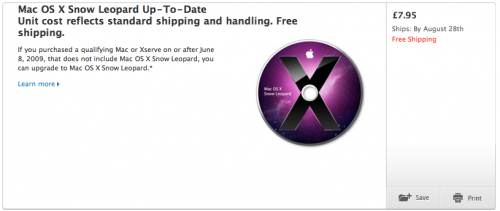
Apple's UK online store is now listing a shipping date for the OS X Snow Leopard "Up-to-Date" program of "by August 28th". The listing comes on the heels of reports fromseveral sources in recent days that Snow Leopard would see an August 28th launch, ahead of Apple's previously-announced September launch window.


A brief survey of the equivalent page at Apple's online stores for a number of other countries currently shows all of them still listing an estimated shipping date of September.

The page appears to only be an informational listing, as users are unable to order Up-to-Date discs directly via the product page in Apple's online store. Customers must first verify that they are eligible for the program through the main Up-to-Date program page, which restricts participation to users who purchased a Mac on or after June 8th, 2009.

Update: Following reports that Apple's online stores for several other countries, including the U.S. and Canada, began showing the "by August 28th" ship date, Apple has now revised all of those listings to again read that the Snow Leopard Up-to-Date disc will ship in "September".
Written by Eric Slivka

Thursday, August 20, 2009

Palm Reportedly Rejected Jobs' Proposal Not to Poach Each Others' Employees

Bloomberg reveals that Apple CEO Steve Jobs reportedly approached then-Palm CEO Ed Colligan in August 2007 with a proposal that the two companies refrain from hiring each others' employees. Colligan rejected the proposal, claiming that the tactic was wrong and "likely illegal."

Colligan, who stepped down as CEO in June, discussed the matter with Jobs in August 2007, as the mobile-phone war heated up, according to the communications. Apple had introduced the iPhone two months earlier, just as Palm hired a former Apple executive, Jon Rubinstein, to develop new smart phones. Jobs, Apple's CEO, told Colligan he was concerned that Rubinstein was recruiting Apple employees. "We must do whatever we can to stop this," Jobs said in the communications.

While the exact proposal made by Jobs was not discovered by Bloomberg in its review of communications between Jobs and Colligan, Colligan's response indicates that an anti-poaching deal was in fact proposed.

"Your proposal that we agree that neither company will hire the other's employees, regardless of the individual's desires, is not only wrong, it is likely illegal," Colligan said to Jobs, 54, according to the communications. Colligan said he thought about Jobs's proposal and considered offering hiring concessions, before deciding against it, according to the exchanges.

The report comes on the heels of another claim that Apple and Google had a similar informal agreement during Google CEO Eric Schmidt's term on Apple's Board of Directors, a situation being investigated by the U.S. Department of Justice for possible antitrust violations.

Palm and Apple have developed an intense rivalry over the past several years as Rubinstein and a number of other former Apple employees have played key roles in rebuilding Palm with the development of the Palm Pre and its webOS operating system. On a conference call in January several weeks after the Pre's announcement, Apple Chief Operating Officer Tim Cook made what was viewed as veiled threats against Palm regarding multi-touch and other intellectual property claimed by Apple that has appeared in similar forms in the Pre. Palm and Apple have also continued to spar over the Pre's ability to sync media directly from iTunes by presenting itself as an iPod in its vendor and device identification codes.
Written by Eric Slivka

COMMENT ON THIS POST FOR THE CHANCE TO WIN A FREE $25 ITUNES GIFT CARD!

Apple Releases Fix for MacBook Pro Hard Drive Issues

Apple today released Hard Drive Firmware Update 2.0, addressing issues with certain hard drives on the latest MacBook Pros models. Apple had been reported last week to be working on the issue, which involves intermittent "beeping" noises and occasional brief system freezes on machines using 500 GB, 7200 rpm hard drives.

MacBook Pro Hard Drive Firmware Update 2.0 reduces certain infrequent noises made by 7200-rpm drives.

These drives shipped with the June 2009 MacBook Pro.

To complete the firmware update process, please follow the instructions in the updater application (/Applications/Utilities/Hard Drive Update.app).

The updater will launch automatically when the installation is complete.

New Hard Drive firmware will be: 0007APM2

As the issue was first gaining attention in the first days after release, it was judged to likely be stemming from the G-Force anti-shock protection mechanism found in the Seagate Momentus drives used by Apple. The G-Force mechanism is essentially redundant to Apple's own Sudden Motion Sensor technology included in its notebook computers, but it is unclear exactly what steps Apple took with this firmware update to address the issue.
Written by Eric Slivka

COMMENT ON THIS POST FOR THE CHANCE TO WIN A $25 ITUNES GIFT CARD

Wednesday, August 19, 2009

Apple's North Carolina Data Center to Focus on Cloud Computing?

Cult of Mac posts an interview with Rich Miller, editor of Data Center Knowledge, regarding possible plans for Apple's $1 billion data centerdue to open in rural Maiden, North Carolina in 2010. At approximately 500,000 square feet and roughly five times the size of the company's existing center in Newark, California, Apple's new data center will be among the largest in the world, sparking questions about what the company plans to do with the capacity.

While public figures closest to the Apple deal acknowledge only that the project will support existing iTunes and MobileMe services, speculation has arisen that Apple may be planning a significant foray into "cloud computing", allowing users to move applications and data to Internet-based locations accessible from any Web-enabled device.

One of the leading theories about the size of the NC project is that Apple is planning future cloud computing services that will require lots of data center storage. Cloud computing is a hot trend, and I'd be surprised if Apple isn't thinking hard - and thinking differently - about cloud computing. Many cloud enthusiasts say that cloud computing will eliminate the need for data centers. In reality, the only thing will change is the owner of the building. All the applications and data that are moving into the cloud will live on servers in brick-and-mortar data centers. The companies that are building the biggest data centers tend to also have the biggest cloud ambitions.

Apple until now has used content delivery networks (CDNs) such as Akamai and Limelight Networks to serve significant amounts of content to users, and some have speculated that the new data center will allow Apple to achieve cost savings by bringing a significant part of that third-party content delivery system in-house. Miller, however, points to Apple's data center's rural location far from the network-dense areas where content delivery centers are typically located as a sign that Apple is pursuing cost and scale efficiency rather than the connectivity most dedicated delivery networks are looking for.

Facebook cited latency to Europe as a key factor in its decision to add data centers in Virginia. Before that, MySpace added a data center in Los Angeles to reduce its reliance on CDNs. But in both cases, those companies sought out Internet hubs where they could connect with dozens of other networks to manage their Internet traffic. You don't get that in rural North Carolina, so Apple seems more focused on cost and scale than on connectivity - which again would suggest a cloud focus.

Written by Eric Slivka

COMMENT ON THIS POST FOR THE CHANCE TO WIN A $25 ITUNES GIFT CARD.

Tuesday, August 18, 2009

iTunes Share of U.S. Music Sales Reaches 25%

Market research firm NPD today reports that Apple's iTunes was the number one music retailer in the U.S. for the first half of 2009 with 25% of unit sales. Apple's share of the total market is up from 21% in 2008 and 14% in 2007.

According to NPD MusicWatch, when it comes to the unit-sales volume of music sold at retail – including paid digital music downloads and CDs – Apple iTunes leads in the U.S. with 25 percent of music units sold, which is up from 21 percent in 2008 and 14 percent in 2007. Walmart (including Walmart, Walmart.com, Walmart Music Downloads) remains in second position with 14 percent of music volume sold at their stores and Web sites with Best Buy ranked third.

The move comes as the music industry continues to see a shift from CDs to digital downloads, with digital downloads now accounting for 35% of total sales, up from 30% in 2008 and 20% in 2007. As the trend continue, NPD sees digital download sales equalling CD sales by the end of 2010.

Within the digital download segment, iTunes easily claimed the top spot with 69% of the segment for the first half of 2009, followed by Amazon at 8%. iTunes has led the digital download segment essentially since its inception in 2003.

Apple announced to its employees in April 2008 that it had recently become the #1 overall music retailer in the U.S., and Apple's lead over #2 Walmart has continued to increase since that time.
Written by Eric Slivka

Apple Media Event Scheduled for September 9th? No Tablet Announcement?

All Things Digital reports that Apple has scheduled a media event for Wednesday, September 9th in San Francisco. The event will presumably take place at the Yerba Buena Center for the Arts where similar Apple events have been held in the past, and will be focused on iPod and iTunes updates. The sources claim that no mention will be made of Apple's much-anticipated tablet computer.

The event will be held in San Francisco -- most likely at Yerba Buena Center for the Arts, where it has occurred in years past -- and is expected to showcase upgrades to the iPod line and an update to iTunes that may involve some sort of social element. Our sources insist it will not involve any discussion whatsoever of the tablet that Apple is reportedly developing.

There is no word yet on whether Apple CEO Steve Jobs will be presenting for the first time since his return from a medical leave of absence for a liver transplant.

Reports last week at pointed to a media event scheduled for sometime during the week of September 7th, and other sources have also claimed that there will be no tablet introduction at the event.
Written by Eric Slivka